
Casino Laws in Australia: What’s Actually Legal Online
 Available in AU
Legal Status of Online Casinos and Bonus Offers in Australia
Australia’s relationship with gambling regulation presents a curious architectural anomaly: a single country lacking a single overarching statute, where the rules shift depending on whether one discusses physical premises or digital platforms. This fragmentation is not accidental. It reflects layers of state and federal authority accumulated over decades, resulting in a system where the legality of an activity depends entirely on the venue—and where "venue" means either brick-and-mortar or internet-based.
The federal government governs online gambling through the Interactive Gambling Act 2001 (IGA). Different levels of authority handle traditional casinos. The result is a peculiar regulatory mosaic.
The Architecture of Prohibition
The Interactive Gambling Act 2001 operates as Australia’s primary legislation controlling online gambling activities. Enacted with explicit public-protection goals and harm-minimisation language, this Commonwealth-level law drew sharp boundaries around acceptable digital gaming formats.
Under the IGA, offering online casino-style games to residents violates federal law. The prohibition specifically encompasses slots (known locally as pokies), poker, blackjack, and roulette. These restrictions apply universally, regardless of where the operator is based.
Choosing a casino worth your time means weighing the welcome offer against licensing, payout speed, and deposit requirements before you commit any money. This shortlist breaks down what each operator actually brings to the table.
Bonus: 240% up to A$4,100 + 300 free spins Stands out for a heavily loaded welcome package, combining a large percentage match with a generous batch of free spins.
License: Curacao eGaming (Roby Games Ltd) · Bonus: 100% up to A$750 + 200 free spins Operates under a Curacao eGaming licence and pairs it with a straightforward welcome bonus that includes both a deposit match and free spins.
License: Curacao Gaming Control Board OGL/2023/176/0095 (Hollycorn N.V.) · Bonus: up to A$11,000 + 300 free spins (code NEO100) Licensed via the Curacao Gaming Control Board, it offers one of the larger deposit-match ceilings on this list along with a substantial free spins allowance and a dedicated bonus code.
License: Curacao OGL/2024/1335/0780 · Bonus: up to A$1,000 + 150 free spins, wager-free · Min. deposit: EUR 20 Holds a current Curacao licence and offers a wager-free bonus structure with free spins, plus a low minimum deposit requirement.
Bonus: up to A$7,500 + 550 free spins across 10 deposits, 50x wagering · Payout speed: crypto under 1 hour, PayID 1-3 business days · Min. deposit: A$20 (A$30 to qualify for the bonus) Spreads a large bonus across multiple deposits with free spins included, and is notable for fast crypto payouts alongside quick PayID processing.
License: Curacao eGaming OGL/2024/923/0383 (Antillephone N.V.) · Bonus: up to A$2,000 + 100 free spins across 2 deposits · Min. deposit: A$30 Licensed under Curacao eGaming, this operator splits its bonus across two deposits with free spins and keeps the minimum deposit accessible.
License: Curacao Gaming Authority (Jumpman Gaming Ltd) · Bonus: up to A$6,600 + up to 250 free spins across 4 deposits Regulated by the Curacao Gaming Authority, it offers a sizeable bonus spread over four deposits along with a solid free spins package.
License: Tobique Gaming Commission · Bonus: up to A$8,000 + 400 free spins across 4 deposits · Payout speed: crypto ~10-15 minutes, fiat 1-5 days · Min. deposit: A$30 Licensed by the Tobique Gaming Commission, it combines a large multi-deposit bonus with free spins and stands out for fast crypto payout times.
License: Curacao · Bonus: 100% up to A$500 + 200 free spins, 10x wagering · Payout speed: crypto 30-60 minutes, fiat 1-5 days · Min. deposit: A$10 A Curacao-licensed operator with a low wagering requirement on its welcome bonus, fast crypto payouts, and a very low minimum deposit.
License: Curacao Gaming Control Board OGL/2023/176/0095 (Hollycorn N.V.) · Bonus: up to A$1,500 + 200 free spins across 3 deposits Licensed through the Curacao Gaming Control Board, it offers a bonus split across three deposits with a solid free spins component.
Crucially, the statute targets operators rather than players. Individual Australians who access offshore gambling sites do not commit crimes under the IGA. The criminal liability falls on those providing the services, not those consuming them. This distinction matters significantly when examining the practical operation of the online gambling market.
No licence pathway exists for domestic online casino operations. No Australian jurisdiction can authorise real-money online casino services, and operators cannot obtain domestic authorisation. The prohibition is absolute rather than merely regulatory.
Operators Versus Players: The Legal Distinction
The asymmetry between operator prohibition and player permission creates a legally ambiguous market. While no domestic online casino licence exists, Australians regularly access offshore platforms licensed by foreign jurisdictions. These sites operate outside Australian regulatory reach while serving local players.
The Interactive Gambling Act was designed to eliminate domestic operators, not eliminate play. This creates an unusual situation: the games Australians typically play at foreign-licensed casinos remain categorically prohibited if provided locally.
Enforcement and the Regulator’s Reach
The Australian Communications and Media Authority (ACMA) oversees IGA enforcement at the federal level. Its mandate covers online gambling violations, but its power to influence foreign operators remains limited by jurisdictional boundaries.

State and territory regulators—including the Victorian Gambling and Casino Control Commission (VGCCC) and Liquor & Gaming NSW—retain primary responsibility for physical gambling venues. The VGCCC specifically monitors wagering service providers for compliance with the National Consumer Protection Framework. However, these state-level bodies have limited power over offshore online casinos, which operate outside their jurisdictional reach.
This regulatory division creates enforcement gaps. Physical casinos face tight oversight. Offshore online platforms enjoy relative freedom.
The Land-Based Contrast
Physical casinos operate under an entirely separate framework. State government regulators and law enforcement agencies oversee these venues, distinct from ACMA’s online mandate. This separation means Crown Melbourne and The Star Sydney face compliance obligations unrelated to the IGA’s online casino prohibitions. The physical gambling sector remains fully legal and regulated, while its digital counterpart remains banned.
Bonus Schemes and Advertising Restrictions
The IGA establishes simultaneous restrictions on bonus offerings and promotional activities. Offering inducements to open gambling accounts violates the law, and advertising online casino services faces comprehensive bans.
The fragmented regulatory structure means operators theoretically face multiple oversight bodies, yet offshore platforms largely avoid all of them. This leads to a regulatory asymmetry: domestic restrictions coexist with a functioning cross-border market serving Australian players who face no personal legal risk.
The absence of domestic operators and player prosecution exemptions has produced a peculiar outcome. Australians seeking casino games necessarily use foreign-licensed sites, in a legislative environment that prohibits local provision while tolerating foreign consumption.
Illegal Offshore Casinos
Playing at offshore online casinos carries significant legal and financial risk for Australian players, as operators are prohibited from offering services to Australian residents and have no recourse under Australian consumer protection schemes.
The National Consumer Protection Framework
The VGCCC’s monitoring of wagering providers under the National Consumer Protection Framework represents a coordinated regulatory attempt. This framework operates across state boundaries, applying uniform standards to licensed betting operators regardless of location. Online casino games fall outside this framework because they lack domestic licensing altogether. The framework applies to legal wagering operators, excluding the prohibited casino sector entirely.
The system operates as designed: it regulates permitted gambling while ignoring prohibited categories. Offshore casinos remain inaccessible to such oversight because they exist outside the regulatory structure entirely.
Federal Layering and Structural Implications
Australia’s gambling regulation operates through simultaneous federal and state/territory authority. The IGA establishes nationwide online gambling prohibitions, while state regulators maintain separate jurisdiction over physical venues. This layering means an activity may be legal in physical form while prohibited online, depending entirely on the delivery method rather than the activity itself.
Bonus offer legality follows identical logic. Domestic regulation of promotional activity requires domestic operation. Offshore sites exist beyond this reach, operating in promotional environments unavailable to Australian-licensed entities.
The Market’s Persistent Paradox
Australians constitute gambling participants despite the regulatory prohibitions. The IGA has not eliminated gambling; it has redirected it toward foreign operators who face no domestic oversight. Offshore sites capture market demand through regulatory arbitrage, not consumer preference.

This structure suggests deliberate legislative choice rather than regulatory failure. The focus remains harm minimisation rather than harm elimination. The system concentrates on protecting players from unregulated operators rather than preventing play itself.
The prohibition operates primarily as a licensing restriction, not a usage prevention mechanism. Foreign operators access Australian consumers through a legal framework that prohibits domestic provision while permitting foreign consumption.
Pokies and Other Online Gaming Formats: What Australians Can Actually Play
Australia operates what might charitably be called a fragmented gambling system, and what might more accurately be described as organised chaos dressed in legislation. There is no single national gambling authority, no unified playbook, and certainly no consensus about what should be permitted. Instead, regulation splinters across federal and state levels like light through a prism, creating a peculiar geometry where pokies exist in a legal twilight, sports betting thrives under licence, and neither group particularly wants to share a room with the other.
That fragmentation matters. When someone asks which games Australians can actually play online, the honest answer requires first understanding that the country has no single answer—only a federal act, several state frameworks, and the Australian Communications and Media Authority attempting to impose some order on the whole affair.
The Federal Line on Casino-Style Games
The Interactive Gambling Act 2001 draws a fairly hard boundary around what cannot be offered to Australian residents online. That list includes pokies, poker, blackjack, roulette and essentially any casino-style game you might find in a physical venue. This is not a grey area or a jurisdictional ambiguity. These games are federally prohibited under the IGA, and ACMA enforces that prohibition with the kind of enthusiasm usually reserved for customs inspections.
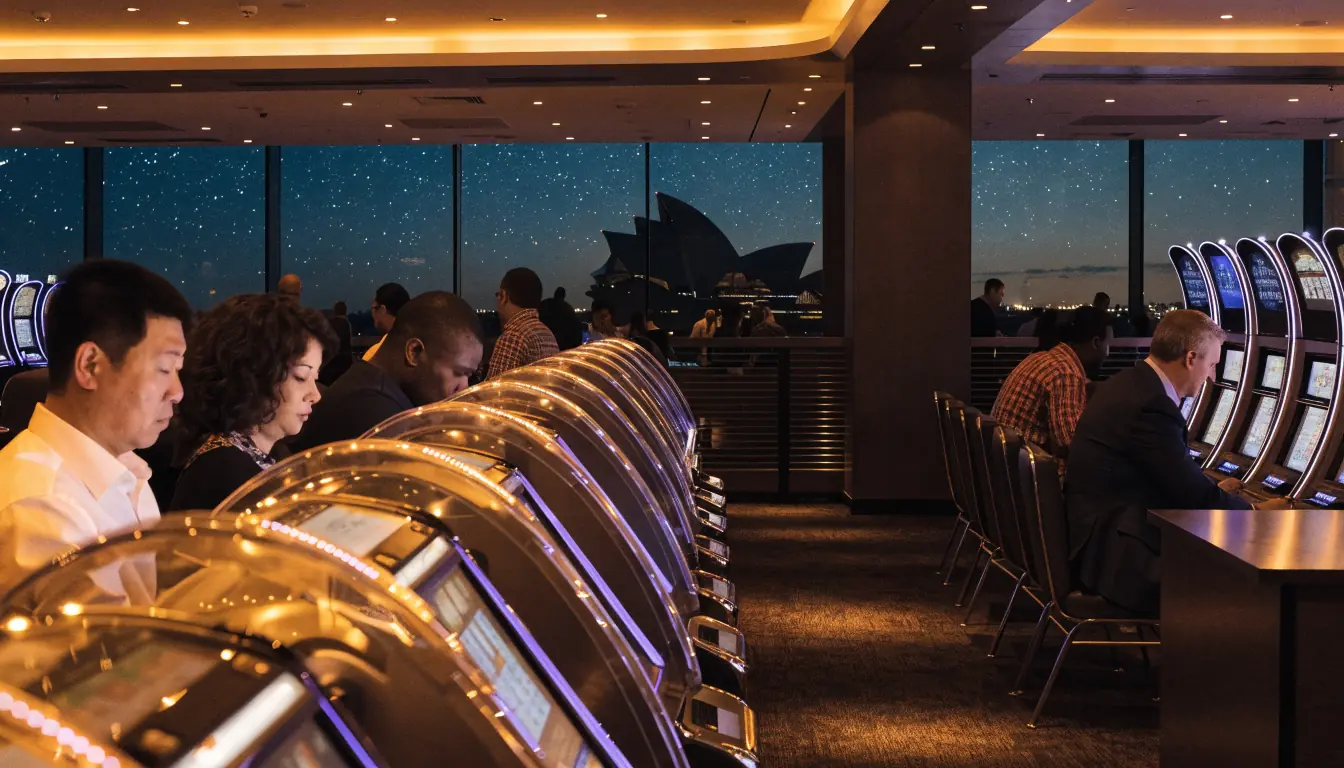
The practical consequence is straightforward: no Australian operator can legally provide online pokies to residents. None. The prohibition targets the operators, not the individual players, which means an Australian sitting at home playing pokies on an offshore site is not committing a federal offence. The operator, however, is breaking the law by offering that service. This distinction has produced the peculiar ecosystem where Australia’s regulator essentially plays regulatory whack-a-mole with offshore casinos, blocking sites as fast as they appear.
What the States Permit
Yet the chaos deepens when you look at what is actually permitted. Each state and territory runs its own gambling regulator with its own priorities and licensing frameworks. Sports betting online operates legally under state licences, and has done so for years. The pokies that Australians cannot access online are, of course, ubiquitous in physical venues—clubs, hotels, casinos—regulated separately by state governments and law enforcement.
This creates a situation of remarkable inconsistency. A resident of Victoria can walk into a local venue and play pokies regulated by the Victorian Gambling and Casino Control Commission without issue. The same person cannot access those identical games online. The difference is not about the games themselves but about the medium through which they are delivered, and that distinction has produced one of the stranger regulatory cartographies in the developed world.

Sports betting online, unlike pokies, represents a permitted format under state licensing. Bookmakers licensed in the Northern Territory, or registered in various states, can offer online wagering on sporting events legally. This distinction between permitted and prohibited formats has shaped the entire competitive landscape. When operators talk about what they can offer Australians, the permitted formats—sports, racing, certain other wagering products—represent the only legal ground on which domestically licensed operators can stand.
The In-Play Paradox
Perhaps the most elegant illustration of Australia’s regulatory fragmentation is the rule around in-play betting. Betting on live sporting events after the match has commenced is prohibited online. Betting on those same live events by telephone is permitted. One medium: forbidden. Another medium: legal. The distinction appears designed to protect consumers, but the practical effect is that a punter with a mobile phone can legally place live bets in a way that someone attempting the same transaction through a website cannot.
This paradox sits at the heart of what Australians can actually play. The games that are available depend not on the nature of the game itself but on the technological tunnel through which it travels to the player. Online pokies: prohibited. Telephone customer service facilitating live sports betting: permitted. The same fundamental activity—wagering on an event as it unfolds—shifts legal status depending on whether ACMA can intercept the digital transaction or a human voice confirms the bet.

Offshore Options and the Actual Playing Field
What Australians actually play, in practice, includes offshore online casinos offering pokies, slots and casino games to anyone with an internet connection and a functioning payment method. These operators exist in a legal twilight—they hold licences from Malta, Curacao, Kahnawake or the UK, jurisdictions that have granted them legitimate regulatory status. ACMA can block their websites. ACMA cannot, however, undo the existence of their offshore licences or prevent Australians from attempting to access them.
The regulator addresses this through a strategy of systematic whack-a-mole. Since November 2019, ACMA has ordered Australian internet service providers to block access to illegal gambling sites, creating a perpetual cataloguing exercise where new offshore casinos appear and are subsequently blocked. The regulator cannot recover funds for players or settle individual disputes with offshore operators, which means the actual playing field for Australians seeking to play pokies online involves navigating sites that may vanish at any moment and operators over whom Australian regulators have limited power.

The permitted formats—sports betting, racing wagering—represent the only legal landscape where Australian players can engage with licensed operators in their own regulatory environment. Once the desire shifts to casino games, the only available options are offshore, illegal from the operator’s perspective, and protected by the regulatory gap that defines Australian gambling law.
What This Means for the Actual Player
An Australian examining what they can play must first reckon with the distinction between what is permissible and what is accessible. Online pokies are not permitted. Online sports betting is. Pokies in a pub are permitted under state regulation. Pokies online are not. The same game, different legal status depending entirely on the medium of delivery.
Offshore casinos fill the vacuum created by that prohibition. They advertise pokies and casino games to Australians, and Australians play them, despite the operators breaking Australian law in the offering. The individual bears no criminal liability for accepting the offer. The operator bears the legal responsibility. This asymmetry has created a market where the only legal operators domiciled and regulated in Australia are the sports betting and racing providers. Everything casino-style exists in the shadow territory that ACMA perpetually tries to police while the state regulators maintain their own, entirely separate domains.
The patchwork persists because no single authority governs the whole terrain. The Commonwealth prohibits casino games. The states permit and regulate them physically. ACMA enforces the federal prohibition with considerable determination. The state regulators pursue their own frameworks with similar vigour. Between them all, Australians seeking to play pokies online do so in circumvention of the Interactive Gambling Act, whether they fully understand that legal landscape or not.

That is the answer to which formats Australians can actually play: the permitted ones are narrow and specific, the prohibited ones are widely available offshore, and the entire edifice operates without unified national oversight because Australia never quite decided whether gambling regulation belonged to one level of government or several. The result is that what you can play depends entirely on which jurisdiction controls the particular medium of the particular game at the particular moment you seek to engage with it.
Payments, Withdrawals and Consumer Protections for Australian Gamblers
The financial relationship between an Australian gambler and an offshore casino is, by necessity, a quiet one. What the law cannot prevent, it has instead decided to inconvenience — a distinction that shapes everything about how money moves in and out of these sites, and what recourse exists when something goes wrong.
The Architecture of Blocking
Since November 2019, the Australian Communications and Media Authority has been issuing formal notices to Internet Service Providers, directing them to restrict access to gambling sites that breach the Interactive Gambling Act 2001. The sites targeted are typically online casinos — the category of gambling that Australia has drawn the hardest line against, alongside online slots and in-play sports betting.
The results, depending on which source one consults, either demonstrate significant reach or raise questions about methodology. As of publication in 2024, ACMA had blocked 975 illegal gambling and affiliate websites. A more recent accounting from iclg.com, published in August 2025, puts the figure at 1,296 sites and affiliates. The difference likely reflects timing rather than contradiction, but the lack of a single consolidated public dashboard means consumers are working with incomplete information — a discomfort familiar to anyone who has tracked policy outcomes in this space.
Channelling players toward legal offshore access: that was not the stated purpose. The purpose was disruption, and the blocked sites understand that well. Domain changes are cheap. ACMA’s enforcement strategy has been characterized as resembling a game of whack-a-mole — knock one down, another appears, the regulator swings again. This has been the structural dynamic since the expansion of enforcement powers in 2017, when more than 100 illegal gambling services, including online casinos, left the Australian market — a figure reported by theiaga.org, and one that invites certain questions about how one keeps count of a market that operates in the dark.

One thing the numbers do make clear: the exit was not entirely coerced. According to iclg.com, over 220 illegal services have voluntarily ceased operations in Australia. Voluntariness, in this context, should be read generously — the kind of voluntary departure that comes after a regulator has made the cost of staying prohibitive.
What the Blocking Does to Money
When a site is blocked, what happens to a player’s funds held there is not technically ACMA’s problem. The regulator can investigate. It can issue warning notices. It can refer matters to the Australian Federal Police where illegal gambling products are offered domestically. It can notify border protection agencies of the directors and principals of offending offshore operators. It can even write letters to software developers believed to be ancillary to a contravention of the Interactive Gambling Act. It cannot, however, recover your funds or settle a dispute with a casino based in a jurisdiction that Australia has no standing to compel.
This is the gap into which consumer expectation frequently falls. The player who deposits into a blocked site, then finds the address has changed or the domain seized, is not a person ACMA can assist in any practical sense. The regulator’s enforcement ends at the site level, not the individual account.
So what protection exists? Not nothing, but close to it.
The Instruments Available
The Northern Territory Racing Commission holds a peculiar position in Australian gambling law — it is, in effect, the de-facto national regulator for online bookmakers, owing to lower tax rates in the Territory that have concentrated most national operators under its licence regime. But its authority extends only to the licensed segment. A casino operating without an Australian licence — which, for online casinos, means every casino — is beyond the NTRC’s remit.
The consumer-facing tools that do exist are those that Australia has permitted and built: BetStop, the National Self-Exclusion Register, and Gambling Help Online. These are not recovery mechanisms. They are prevention mechanisms, which the Australian regulatory framework has prioritized over financial recourse — a philosophical choice that says something about whether the state’s primary concern is the individual gambler or the aggregate harm.
KYC processes at offshore casinos introduce a further complication. Identity verification is a precondition for withdrawal at most licensed operators globally; at unlicensed operators serving Australian players, the verification process can be inconsistent, delayed, or absent until the moment a withdrawal is requested. The document check that players bypass at sign-up often arrives precisely when the money is trying to leave. It has the appearance of a technicality. It is more often a policy.
Crypto, ACMA, and the Limits of Enforcement
Bitcoin and Ethereum transactions bypass the traditional banking infrastructure that regulators can monitor, which is one reason they appeal to offshore casinos operating in Australian-adjacent jurisdictions. For players, this creates a form of insulation: a transaction that cannot be traced through a regulated payment channel is also one that cannot be reversed through one.

ACMA’s own limitations compound this. The regulator cannot require platforms like Facebook to block gambling advertisements targeting Australians, owing to the wording of the law prohibiting advertising “in Australia.” The jurisdictional puzzle is not new. It applies equally to cryptocurrencies, foreign software providers, and any entity whose commercial relationship with the Australian market is deliberately ambiguous.
What a player can and cannot recover, and what the law can and cannot compel, are questions that deserve clearer answers than Australia currently provides.
The VGCCC and the National Framework
The Victorian Gambling and Casino Control Commission does monitor wagering service providers for compliance with the National Consumer Protection Framework — including providers based in other states. This is an unusual scope of authority, one that suggests the Framework is intended as a genuine cross-jurisdictional instrument rather than a state matter. But even this does not help with offshore casinos. Providers operating outside Australian licensing are outside the Framework’s effective reach.
There remains, then, a persistent asymmetry: thorough regulation of what is permitted, and no regulation of what is prohibited. The latter is not regulatory failure so much as a definitional consequence — if the activity is prohibited, there is no licensee to regulate, no complaint procedure to avail, no ADR membership to reference. Stormy waters, one might say. The ship has no port.
Liquor & Gaming NSW, the Office of Liquor and Gaming Regulation in Queensland, the Tasmanian Liquor and Gaming Commission — the roll of regulators across states and territories is comprehensive. And the gap remains exactly where the gap has always been: between the licence that exists and the licence that doesn’t.
For the player who has funded an offshore account and is waiting for a withdrawal that has not yet arrived, the honest summary is this: Australia’s gambling infrastructure is built to manage what it authorizes. What it does not authorize belongs to a different conversation — one in which the player is, largely, on their own.
Created by the ”Pokies Payouts Guide” editorial team.