Online Pokies E-Wallet Australia: Scale and Regulation
 Available in US
Australian Pokies: Scale, Economics and Regulatory Environment
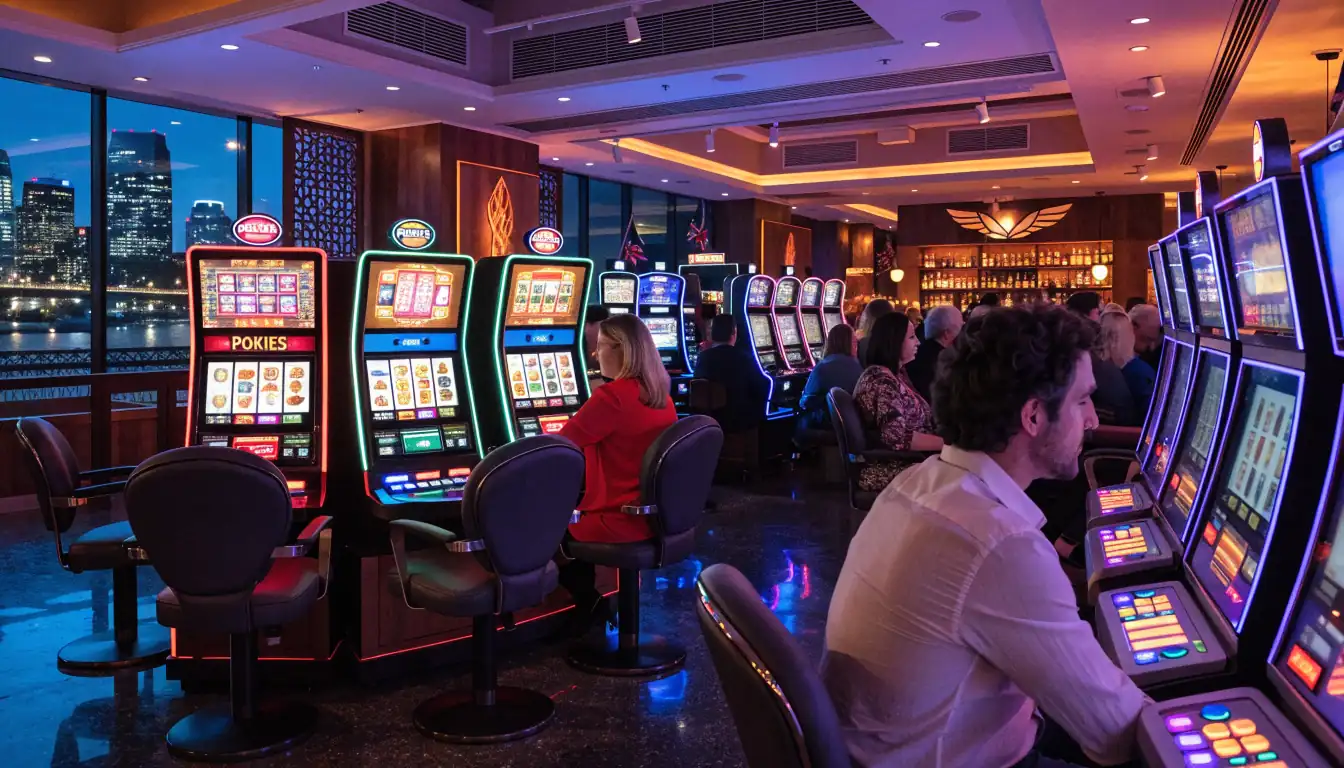
Walk into almost any suburban pub in Australia and you will hear the machines before you see them. Pokies — the local shorthand for electronic gaming machines, a term no Australian needs explained — are not a pastime so much as a piece of national infrastructure, embedded in pubs, clubs and casinos across the country with a density that most visitor nations can barely comprehend. The section that follows this one will deal with the narrower question of how e-wallets interact with the online versions of these games; this section sets the stage, the machinery and the law into which an e-wallet would have to fit.
A machine census with two answers
Electronic gaming machines operate legally in every Australian state, in the Australian Capital Territory and in the Northern Territory. No other leisure product enjoys that kind of universal geographic coverage, and coverage is the right word — the pokies lounge is as standard an amenity in a regional RSL club as the bar it sits behind.
If you’re weighing up e-wallet-friendly pokies sites for 2026, welcome offers and payout logistics are worth checking before you sign up, since they shape how quickly your deposits and withdrawals actually move.
Bonus: 240% up to A$4,100 + 300 free spins Stands out for a large percentage match bonus paired with a generous free spins package, making it a notable pick for players chasing sign-up value.
License: Curacao eGaming (Roby Games Ltd) · Bonus: 100% up to A$750 + 200 free spins Operates under a Curacao eGaming licence and backs its welcome offer with a solid free spins allowance, giving new players a straightforward entry point.
License: Curacao Gaming Control Board OGL/2023/176/0095 (Hollycorn N.V.) · Bonus: up to A$11,000 + 300 free spins (code NEO100) Licensed under the Curacao Gaming Control Board, it offers one of the higher welcome bonus ceilings on this list plus a bonus code and a substantial free spins bundle.
License: Curacao OGL/2024/1335/0780 · Bonus: up to A$1,000 + 150 free spins, wager-free · Min. deposit: EUR 20 Curacao-licensed with a wager-free welcome bonus and free spins, plus a low minimum deposit requirement that keeps entry accessible.
Bonus: up to A$7,500 + 550 free spins across 10 deposits, 50x wagering · Payout speed: crypto under 1 hour, PayID 1-3 business days · Min. deposit: A$20 (A$30 to qualify for the bonus) Spreads a sizeable bonus and hundreds of free spins across multiple deposits, and is notable for fast crypto payouts alongside PayID processing within a few business days.
License: Curacao eGaming OGL/2024/923/0383 (Antillephone N.V.) · Bonus: up to A$2,000 + 100 free spins across 2 deposits · Min. deposit: A$30 Holds a Curacao eGaming licence and offers a multi-deposit welcome package with free spins, backed by a modest minimum deposit threshold.
License: Curacao Gaming Authority (Jumpman Gaming Ltd) · Bonus: up to A$6,600 + up to 250 free spins across 4 deposits Licensed via the Curacao Gaming Authority, it spreads a large bonus and free spins allowance across several deposits for players who plan to fund their account more than once.
License: Tobique Gaming Commission · Bonus: up to A$8,000 + 400 free spins across 4 deposits · Payout speed: crypto ~10-15 minutes, fiat 1-5 days · Min. deposit: A$30 Licensed by the Tobique Gaming Commission, it combines a substantial multi-deposit bonus with notably quick crypto payout times and a reasonable minimum deposit.
License: Curacao · Bonus: 100% up to A$500 + 200 free spins, 10x wagering · Payout speed: crypto 30-60 minutes, fiat 1-5 days · Min. deposit: A$10 Curacao-licensed with a low minimum deposit and a bonus carrying light wagering requirements, plus fast crypto payout turnaround.
License: Curacao Gaming Control Board OGL/2023/176/0095 (Hollycorn N.V.) · Bonus: up to A$1,500 + 200 free spins across 3 deposits Licensed under the Curacao Gaming Control Board, it offers a welcome package with free spins spread over several deposits.
How much of the world’s supply Australia holds is, oddly, a matter of dispute. Depending on which inventory you consult, the share is put at either 3% of the world’s pub and club machines or, in the less conservative estimate, roughly 18% of the global total. A spread that wide says less about arithmetic than about classification — whether you count only community venues or every device everywhere. Choose your definition, and the number follows.
The arithmetic of a national habit
In the financial year 2020–2021, Australians wagered close to AUD 150 billion on electronic gaming machines. Out of that turnover came roughly AUD 12 billion in player losses, which works out to AUD 608 per head of population in a single year. That is not a rounding error on a spreadsheet; that is per capita, across adults and children alike, in one reporting period.
A single-source publication, complyadvantage.com, reports that pokies generated AUD 191.2 billion in gambling turnover during 2023. Whether that figure represents a trend, a peak or simply a methodology, it cannot be treated as the established norm of the market — it is one source’s account, quoted here as such, and the market itself has published no definitive benchmark.
What the verified figures do establish is the shape of the business. Gambling operator taxation in Australia is not one system but several, varying by state and by the type of gambling service offered, so a pie chart of government revenue from pokies would be a different pie chart in each jurisdiction. On the player’s side, one feature of the Australian system deserves its reputation abroad: gambling winnings are not taxed. The reason for that is not generosity; it is that the government taxes the operator at the venue level, which keeps losses cleanly deductible and avoids the administrative swamp of taxing casual winners. Players, in effect, are taxed only once — at the machine.
Gambling losses are not taxed, but operators face heavy compliance penalties for AML breaches. Players should be aware that illegal cash‑intensive activity can lead to criminal investigation.
What the law forbids, and what it permits
Two regimes coexist in Australia, and the pokies question cannot be understood unless both are kept in view. The first is the Interactive Gambling Act 2001, the primary Commonwealth statute governing online gambling; the second is a long tail of state and territory legislation that governs machines in physical venues. The federal Act, in the words of its own purpose, targets operators rather than players — it makes offering real-money online casino services to Australian residents an offence, and the field the section after this one explores sits squarely in that prohibited space.
The obligations that govern the physical machines, meanwhile, are calibrated by machine count rather than by revenue. Operators running up to 15 pokies must register with AUSTRAC, keep customer identification records and submit suspicious matter reports. Operators with more than 15 machines face the full AML/CFT programme: appoint a compliance officer, conduct risk assessments, perform customer due diligence and report all cash transactions above AUD 10,000. Non-compliance is not treated as an internal affair; remedial directions, infringement notices, civil fines and reputational damage are all on the enforcement menu.
New South Wales has not contented itself with the standard menu. An amendment to the Casino Control Act 1992 now allows the state’s casino operators to be fined up to AUD 100 million for compliance failures — a ceiling designed to be noticeable in any boardroom.

Why the watchdogs care about poker machines
The qualities that make pokies commercially successful — high transaction volume, cash in, cash out, minimal record-keeping at the point of play — are precisely the qualities that attract launderers. The high volume of cash transactions and limited traceability of pokies make them attractive for money laundering; according to the same single-source publication, complyadvantage.com, money mules are recruited to run dirty funds through the machines, and that claim, too, is quoted here as reported rather than as market canon.
The laundering methods regulators describe are mundane rather than glamorous: insert a large sum of cash, perform minimal gambling activity, and cash out so the machine prints what reads as a record of winnings. Another variant involves buying winning tickets from other players to convert dirty money into clean, traceable funds. A third, structuring across venues, spreads smaller deposits across different venues so no single operator’s cash threshold is tripped. AUSTRAC’s 2024 guide to recognising money-laundering red flags catalogues warning markers: unusually high cash access, large deposits, cash transfers, casino disbursement checks and certain occupations that correlate statistically with laundering risk. Further red flags include large or repeated cash insertions followed by minimal play and immediate cash-out, frequent small redemptions across different venues within a short period, and customers who refuse identification or who use multiple player cards.
The 2022 NSW Islington Report recommends all pokies become cashless by 2028, aiming to improve traceability and reduce laundering risks.
The regulators’ recommended prescriptions, consistent enough to list together, are tighter customer due diligence, more systematic transaction monitoring and the adoption of cashless gaming systems.
The cashless experiment and the Islington Report
If cashlessness were only a compliance recommendation, it might remain a white-paper talking point. In New South Wales it became a political commitment: the 2022 NSW Islington Report, according to the single-source account already cited, recommended that all pokies in the state become cashless by the end of 2028 — again, quoted here as reported, not as the settled law of the jurisdiction.
According to facctum.com, adoption of cashless, account-based pokies improves traceability and reduces anonymity, and the same source reports that transparent, account-based systems provide full traceability of deposits, gameplay and withdrawals. These are published observations, not invented claims, and they explain why a lobby that once treated cash as a neutral convenience now treats cashlessness as the entire point of the exercise.
Wherever the debate over mandates lands, the e-wallet question — the subject the next section takes up — enters the picture at exactly this point. E-wallets are, after all, what an account-based, traceable payment method looks like from the player’s side of the counter; how and whether they have been integrated into the pokies environment depends entirely on the regulatory environment sketched here.



Or, to put the whole thing in its most Australian form: the machines are national, the losses are per capita, and the paperwork is federal.
E‑Wallet Pokies and the Reality of No‑Deposit Bonuses
The pairing of the e‑wallet and the no‑deposit bonus is a marriage of two ghosts.
Remember the e‑wallet. While Australia’s land‑based egms are shifting toward account‑based cashless systems designed to trace every cent, the online environment operates on a different logic. E‑wallets remain the vestigial machinery of the pre-traceability era, offering a buffer of anonymity between a bank account and a gaming session. For a resident seeking to load an offshore account, they offer a familiar comfort in a market that legally isn’t supposed to exist. Under the Interactive Gambling Act 2001, the operator commits an offence by offering the play; the player, in a familiar act of legal asymmetry, escapes the touch of the law.
This brings us to the no‑deposit unicorn. It is a lure still flickering on affiliate screens, a vestige from an era before traceability. The fine print is littered with wagering hoops and empty promises. The reality? It’s a phantom. And the winnings aren’t taxed. A curious consolation.
What are pokies in Australia?
Pokies are the local shorthand for electronic gaming machines, which are legally operated in pubs, clubs, and casinos across all Australian states and territories.
What law governs online gambling in Australia?
The primary Commonwealth statute is the Interactive Gambling Act 2001, which targets operators by making it an offence to offer real-money online casino services to Australian residents.
Are gambling winnings taxed in Australia?
No, gamblers’ winnings are not taxed. The government taxes the operators at the venue level instead, keeping casual player winnings tax-free.
Created by the ”Pokies Payouts Guide” editorial team.