Best Pokies in South Australia: SA Guide for 2026
 Available in US
Understanding Pokies in South Australia: Types, Mechanics, and Player Considerations
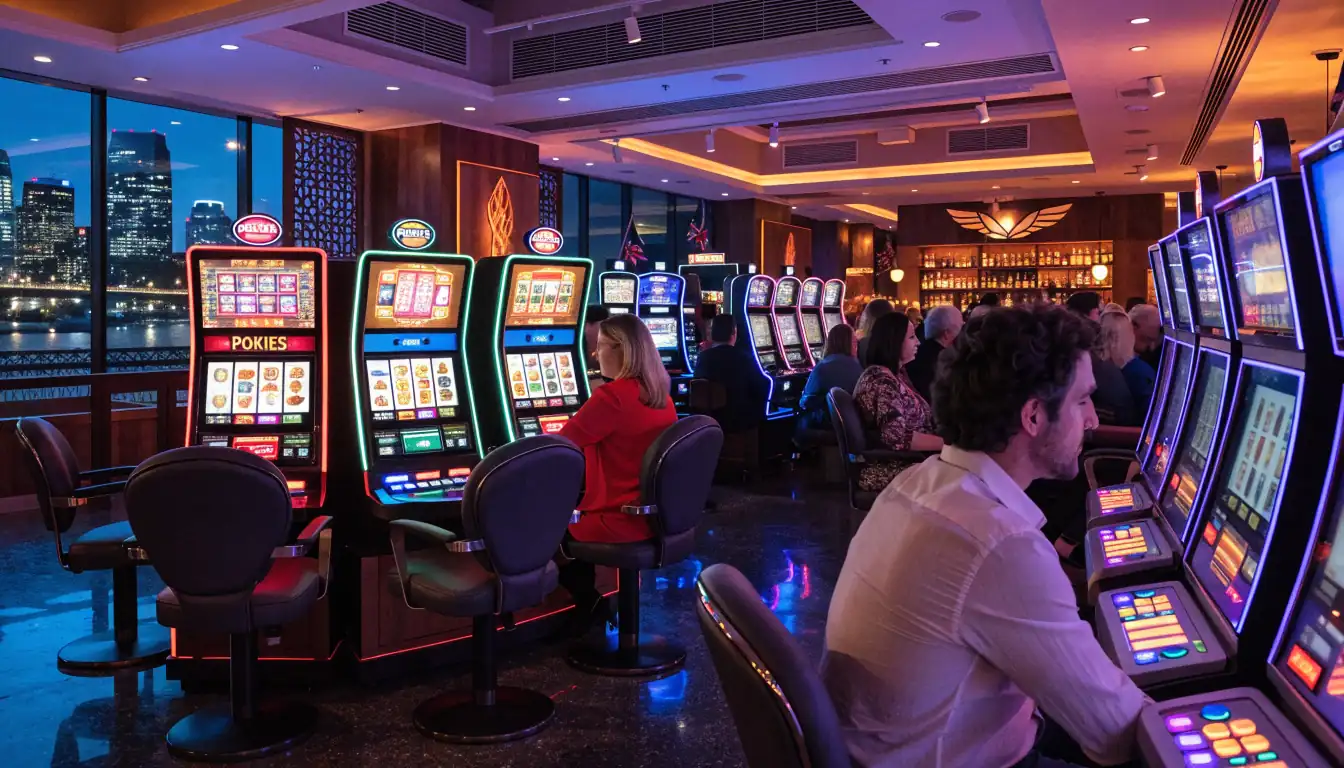
In Adelaide, pokies migrate smoothly from gaudy casino floors into suburban clubs that seem older than the pine‑lining on the walls. They whirr behind open doors long before midday and—at the few venues granted late‑night licences—still glow at three in the morning, issuing their come‑hither chime to anyone else awake. The machines themselves look reassuringly simple: five or six vertical reels, a Spin button on the right, and a paytable tucked behind an “i.” Behind that modest façade sits a mathematics been polished for a hundred and fifty years—because pokies are reel-based casino games offering simple play but a huge variety, much the way a suburban front room hides an entire family history in the sideboard.
South Australians tend to forget how caged the enterprise once was. For most of the twentieth century the state took a dim view of public gambling; the poker machine truly arrived in licensed hotels only after the Torrens government gave way to more pragmatic health ministers, and it came flanked by a regulator that promised oversight about as light as a Key Bridge toll. Early machines were clunky cabinets engraved with eucalyptus leaves and lacquered shillings. The 1990s introduced micro‑processors, so the reels started spinning on a video screen rather than on gears and bells, and the fun hid itself deeper into the circuitry. Modern cabinets are run by random number generators—numerical folklore transformed into bright pixels.
Before spinning the reels at any pokies site in South Australia, it pays to check what each operator actually offers — from licensing to bonus terms and payout speed — so you can pick one that fits how you play.
Bonus: 240% up to A$4,100 + 300 free spins WinShark stands out for its sizeable welcome package, pairing a large percentage match with a generous batch of free spins.
License: Curacao eGaming (Roby Games Ltd) · Bonus: 100% up to A$750 + 200 free spins Roby Casino operates under a Curacao eGaming licence via Roby Games Ltd, backing its welcome offer of a matched bonus plus free spins.
License: Curacao Gaming Control Board OGL/2023/176/0095 (Hollycorn N.V.) · Bonus: up to A$11,000 + 300 free spins (code NEO100) Neospin holds a Curacao Gaming Control Board licence through Hollycorn N.V. and offers one of the larger welcome bonuses on this list, complete with free spins and a redeemable code.
License: Curacao OGL/2024/1335/0780 · Bonus: up to A$1,000 + 150 free spins, wager-free · Min. deposit: EUR 20 Vegaz Casino is licensed under Curacao OGL and pairs its bonus with free spins on wager-free terms, plus a modest minimum deposit requirement.
Bonus: up to A$7,500 + 550 free spins across 10 deposits, 50x wagering · Payout speed: crypto under 1 hour, PayID 1-3 business days · Min. deposit: A$20 (A$30 to qualify for the bonus) Ricky Casino spreads a large bonus across multiple deposits with free spins included, and is notable for fast crypto payouts alongside a low entry deposit.
License: Curacao eGaming OGL/2024/923/0383 (Antillephone N.V.) · Bonus: up to A$2,000 + 100 free spins across 2 deposits · Min. deposit: A$30 WinSpirit Casino is licensed via Curacao eGaming under Antillephone N.V., offering a multi-deposit bonus with free spins and an accessible minimum deposit.
License: Curacao Gaming Authority (Jumpman Gaming Ltd) · Bonus: up to A$6,600 + up to 250 free spins across 4 deposits DragonSlots Casino, licensed under the Curacao Gaming Authority through Jumpman Gaming Ltd, offers a substantial bonus spread across several deposits with a solid free spins allowance.
License: Tobique Gaming Commission · Bonus: up to A$8,000 + 400 free spins across 4 deposits · Payout speed: crypto ~10-15 minutes, fiat 1-5 days · Min. deposit: A$30 SkyCrown is licensed by the Tobique Gaming Commission and combines a large multi-deposit bonus with notably quick crypto payout times.
License: Curacao · Bonus: 100% up to A$500 + 200 free spins, 10x wagering · Payout speed: crypto 30-60 minutes, fiat 1-5 days · Min. deposit: A$10 Wild Tokyo, licensed in Curacao, offers a straightforward welcome bonus with low wagering requirements, fast crypto payouts, and a very low minimum deposit.
License: Curacao Gaming Control Board OGL/2023/176/0095 (Hollycorn N.V.) · Bonus: up to A$1,500 + 200 free spins across 3 deposits LuckyVibe is licensed under the Curacao Gaming Control Board via Hollycorn N.V. and spreads its welcome bonus and free spins across multiple deposits.
Reels, Symbols and the Unit Stake
Ask a South Australian what constitutes “the best” pokie and you will rarely hear a term like return‑to‑player. Older patrons talk about hit rates and “a fair go”; younger ones refer to “ways” or “Megaways” or “that nine‑thousand‑time bet we saw at the cloak‑room.” Under the cosmetics, a single spin is what statisticians call a sample from a binomial probability engine. The player stakes anywhere from a single coin on a populated U‑shaped grid to hundreds of credits at a tap‑of‑a‑toe leisure centre. The only constant is that each press purchases exactly one draw in which no subsequently superior route exists—unless the game literally invokes a feature called Feature Buy. Buy the feature and, typically, the theoretical return to player rises by 0.5 % to 1.5 % above the base value, for a price hovering around the one‑hundred‑times‑the‑bet mark—again, according to the game instructions the auditors release on behalf of their manufacturers.

Pragmatic Play, the content studio now luxuriating inside almost every Aussie‑friendly casino the new‑foundland Anjouan shrieks seek to license, issues a series of games—the “1000” family—that advertise multipliers up to 1,000× on a feature symbol. That catalogue statistic belongs in a page in fine type, yet players finger‑splay across the seat’s lip searching for a visible “maximum exposure” on the glass. The exact number matters little; what matters is presenting potential “maximum exposure” in bold Vegas‑style blue while encouraging the conviction that three quick nappies and a resigned groan are the coin‑drop ancestor equivalent to selecting the feature’s destiny.
RTP, Hypotheses, and the 96‑Percent Threshold
Every qualified pokie carries an internal denomination known as RTP—a long‑term theoretical measure of how much a game returns over many spins. South Australian regulators insist on publication, so the figure is generally visible, small and smudged, at the bottom of the help screen. Players should avoid pokies with an RTP below 96 %; anything less should really be treated as a levy for the public convenience rather than entertainment. High‑RTP titles meeting that benchmark include Merge Up (97.25 %) and Snoop Dogg Dollars (97.00 %)—names as outlandish as Punch cartoons with logic boards. The state’s club industry runs amid perpetual arguments over whether a half‑percentage point justifies an extra malt in the machine’s alcove; the argument flourishes because participants misunderstand what the razor actually cuts. RTP does not tell you your afternoon, only the licence‑holder’s margin in the aggregate.
Low RTP Risk
Playing pokies with an RTP below 96 % significantly increases the likelihood of long‑term loss and should be avoided.
Volatility and Hit Frequency
Beneath RTP lurks volatility, the term that says what sort of game experience fraternises with the advertised percentage.
- Low volatility pokies offer frequent but smaller wins, a scheme for grazing fingers burning loaf after loaf while smiling into pint glasses.
- High volatility pokies embrace an all‑or‑nothing approach with massive wins, capable of blanketing the club in silence on one turn and shotgun confetti on the next.
A balanced pokie has a hit frequency between 25 % and 35 %—meaning a prize of any size roughly once every three to four spins. South Australian problem‑gambling statistics let little sunlight into the private grumble behind those two numbers, yet the machines’ construction is plainly calibrated so the average recreational player perceives “action” often enough to keep their stool warm without wondering whether the department‑store catalogue includes the definition of transparency.
Progressive Jackpots and “Moonrake” Tales
Attracted by the notion that the top prize swells while someone in Roseworthy or Gawler East feeds the beast, lifelong locals gravitate towards progressive jackpot pokies. One industry review describes how those machines “increase their top prize over time as players keep spinning,” which sounds as piratical as any colonial ledger. The operator itself, not a gilt‑edge licence, determines the reset value and incrementing formula. Within that corridor, names like Moonrake occasionally appear—products from niche studios that seasonally surface among the twelve or so reputable offshore suppliers who happen to classify their portfolio as Provably Fair. No mathematically literate spin person should gamble borrowed grocery money on the hope of cornering the progressive; the beast survives independent of anyone’s affection.

Software Lists and the Mythical “Australian‑Friendly Casino”
Suppliers such as Pragmatic Play, BGaming, NetEnt and Evolution Gaming all show up under the same Vegas‑lobby icon in an offshore operator’s lobby, and so the composition of pokies accessible to South Australians depends essentially on an offshore licensing exercise. For a brief period Curaçao issued master licences sealed over early morning cocoa in Willemstad; more recently, the Anjouan Gaming Authority has become the popular alderman of new‑spring websites, with BitStarz, Goldenbet, and the irreverently small Lucky Elf beneath its banner. The variety of software on the paytables of these sites changes every quarter, since studios insert and retract titles faster than the West Beach ice‑cream kiosk changes flavours.
The Australian‑friendly casinos vary widely in the software they offer. Some specialise in no‑wagering pokies bonuses, some chase the “hold‑and‑win” mechanic whose bells promise resonance like a school lunch box falling off a shelf, and some maintain quiet aisles of classic Aristocrat five‑reel releases that have the fluorescent confidence of old pinballs. Progressive Web App technology allows players to add the casino to the home screen without downloading an app—a minor parry around the stubborn fact that Google’s Play store cannot legally host most of these sites inside Australian jurisdiction anyway.
A high‑return title praised for its steady payout structure and modest volatility.
Another top‑RTP game offering solid returns with engaging bonus features.
A niche progressive slot that can deliver a life‑changing win, though the odds are low.
RNG, Audits and the Logic of a Fair Go
Reputable online casinos use RNG‑based games and audited providers. In practice that means the outcome of each spin is determined less by a bunny’s foot tucked into the motherboard and more by a hardware random number generator whose seed is refreshed continuously. Independent testers such as eCOGRA and iTech Labs certify the number‑generator, allowing offshore regulators—be they the Curaçao Gaming Control Board, the Kahnawake Gaming Commission, or the junior clerks of the Anjouan Gaming License—to cram a logo into the operator’s footer. For players this means the pokies behave the same on West Terrace or Warradale at any hour, indeed identical to the behaviour set on production lines in Malta or Isle of Man, except in a now‑and‑then administrative hiccup where the server returns a ferry‑load of user complaints to the operator’s email.
Cashless Terminals and 24‑Hour Accessibility
In South Australia the question is less “What pokie do you like?” and more “Is the room open?”. Clubs and hotels along major arteries like Anzac Highway and Port Road participate in an accreditation system with assigned operating hours, and casino concessions afford around‑the‑clock availability in a kind of club‑density North Terrace corridor that resembles nothing so much as the Casino in Canberra inverted. Cashless pokies arrived several years back in this jurisdiction via tickets instead of rusty coins, and the industry marvel now involves tapping a pre‑verified digital wallet rather than filling one’s hand with shrapnel. Twenty‑four‑hour pokies therefore exist, but the venues palpably licensed for round‑the‑clock running remain numerically few, perhaps a dozen in metropolitan Adelaide, with residual suburban clubs switching off at government bedtime.
Local Etiquette, Globally Tested Content
Ironically, the South Australian eye drifts to machines ordered on days of the week, not to random mechanics. Aristocrat games reigned for decades, then foreign providers like BGaming entrenched themselves among the Provably Fair crowd, while Need for Spin slipped a pyramid of turbo play mechanics into casinos such as mBit and Ignition before the acquired licences could read what the games contained. One corner of Adelaide will tell you pokies are democratic—the magical nine‑line five‑reel cabinet in the Aviation Club differs from a million‑dollar Mega Fortune only by enumeration—while the Salvation Army mess officer suspects there is no democracy in gaming rooms more compelling than anything inherited from European soil. Telling, that.
Players who bother with spreadsheets will note RTP is only a sliding horizontal, that volatility negotiates the lived experience, and that progressive jackpots last roughly as James Bake’s 1966 Toast. Everyone else consumes the machine’s mythology raw. And there is something fitting in that dismissal of strata—the houses rise behind the Cottonwoods for no reason beyond habit, and South Australians might as well exhibit a knack for self‑government by enlivening their imaginations before the machines’ promised probabilities must fold back into their grand historical compliance.
South Australia Pokies Payout Percentages: What Players Should Expect
RTP — the theoretical return to player percentage — decides how much a pokie gives back over many spins, and knowledge of that single figure steers choices in South Australian venues. Gamblers invest time and money weighing probabilities, yet the industry often buries the long odds behind flashing icons and modest promises.
Volatility determines how wins are distributed: low volatility provides frequent small wins, while high volatility yields rare but larger payouts. A balanced slot typically shows a hit frequency of 25 %–35 %.
Practical guidance holds: steer clear of pokies below 96% RTP, a threshold separating worthwhile play from repeated small losses designed to keep the reels hot. Two titles already clear the 96% line with measured payouts — Merge Up sits at 97.25%, while Snoop Dogg Dollars reaches 97.00%. Neither name guarantees profit, but each provides a valuation grounded in numbers instead of hype.
Regulars chasing high volatility seldom pause to contrast those figures, since volatility defines how winnings arrive rather than how frequently. Seasoned players treat the 96% mark as a bench test, marking anything under as reclaimable by the house. The small margin it promises is all the strategy available.
Online Casino Pokies in South Australia: Payment Options and Player Support
The financial mechanics of online pokies in South Australia operate under a peculiar constraint: the Interactive Gambling Act 2001 prohibits operators from offering online casino games to Australian residents, yet individual Australians who play at offshore-licensed casinos face no legal penalty themselves. This creates a market where the burden of legality rests entirely on the supplier, not the consumer—a reversal of the usual regulatory logic that shapes how payment systems and player protections actually function in practice.
PayID has become the dominant transfer method for Australian players, linking a mobile number or email address directly to a bank account without requiring BSB or account numbers. When a casino displays a PayID option, the transaction bypasses traditional card networks entirely. Osko, the real-time payment infrastructure underpinning PayID, settles transactions 24/7. The practical effect: deposits arrive instantly, and withdrawals—when casinos process them promptly—land without the clearing delays that historically plagued offshore gaming.
In July 2025, Australian banks introduced Confirmation of Payee, a service that cross-checks the account name against the entered PayID before funds transfer. For casino transactions, this means a player entering a casino’s PayID sees the registered business name before confirming the payment—a crude but functional safeguard against mistyped details or fraudulent payment instructions. It arrived decades after the need became obvious.
Withdrawal speed remains the single most important factor when choosing where to play. High-performing casino sites process over 90% of payments in under 15 minutes, using digital ID protocols rather than manual verification queues. This metric separates functional operations from those that treat player funds as short-term working capital. The figure also exposes a market stratification: some operators treat rapid payment processing as a competitive advantage; others treat it as an optional feature.
Responsible gambling tools include deposit limits, reality checks, and self-exclusion. These exist across jurisdictions, though their enforcement depends entirely on operator cooperation. A self-exclusion request processed by an offshore casino holds no legal force in Australia; it remains a voluntary agreement between player and operator. The architecture of protection here is contractual, not statutory.
Customer support standards, like payment processing, vary without regulatory minimums. A 24/7 live chat with response time under two minutes has become a standard feature among operators that treat player retention as a technical challenge rather than a marketing exercise. The absence of domestic regulation means these standards function as market signals: they indicate which operators have invested in infrastructure, not merely in advertising.
Wager-free spins—bonus spins without wagering requirements—represent a 2026 trend identified by moviemaker.com. This conflicts with the general market restriction against advertising inducements, yet the claim originates from a single source, not established industry practice. Such promotions, when offered by offshore casinos to Australians, operate in a legal grey zone where federal prohibition meets individual immunity. The state’s stance remains formally prohibitive; the player’s position remains functionally unprotected.
What are the best online pokies to play in Australia?
Players should look for high-RTP titles like Merge Up (97.25%) and Snoop Dogg Dollars (97.00%). It is best to avoid pokies with an RTP below 96%, and choose based on preferred volatility—low volatility for frequent smaller wins or high volatility for massive but rarer payouts.
How to pick a winning slot machine online?
Check the game’s RTP and avoid anything below 96%, as lower figures act more as a levy than entertainment. Also look at the hit frequency, which should sit between 25% and 35% for a balanced experience offering regular action, and consider volatility to match your risk preference.
Where can players find basic game information?
Pokies typically hide their paytable behind an “i” symbol, while the RTP figure is usually visible at the bottom of the help screen. Regulators insist on this publication so players can review the mechanics and theoretical returns before playing.
Should players use bonus buy features?
Buying the feature typically costs around 100 times the bet, but it can raise the theoretical return to player by 0.5% to 1.5% above the base value. Pragmatic Play’s 1000 series, for instance, advertises multipliers up to 1,000x through these features.
Written by the editors at Pokies Payouts Guide.