
Real Cash Online Pokies in Australia: A 2026 Overview
- What Real‑Cash Casino Games Are Available to Australian Players
- Real‑Cash Online Slots: Variety and How They Work
- Cash‑Paying Casino Apps: Choosing Platforms That Actually Pay
- Online Pokies for Real Money in Australia – 2026 Overview
- Depositing and Winning: Low‑Stake Real‑Cash Slots Strategies
- Australian‑Friendly Online Casinos and Slot Providers
- Legal Landscape for Real-Cash Casinos in Australia
- Free‑Play Slots That Can Turn into Real Cash Wins
- How to Find Free Real‑Cash Slot Opportunities
- Winning Real Cash: Tips for Successful Play
What Real‑Cash Casino Games Are Available to Australian Players
The catalogue of games an Australian can load for real money looks, at first glance, like the same wall of titles anywhere else in the world: slots, blackjack, roulette, baccarat, video poker, a handful of dice and crash games, the occasional live‑dealer studio feed. Look a little closer and the picture is odder. Every one of those games exists because the Interactive Gambling Act says it must not exist — at least not from a company holding an Australian licence. The distinction matters, because it decides who is actually dealing the cards.
There is, of course, the well‑rehearsed quirk of Australian usage: the slots that much of the world calls slots are, here, pokies, and asking for online slot games for real cash will get the same answer either way. Table games sit alongside them, and the division between the two families is worth spelling out, because the way each family reaches Australian players in 2026 differs sharply.
The table games on offer
Blackjack, roulette, baccarat and casino poker variants are the stock of any casino floor, physical or digital. In a properly regulated market they would be offered by a licensed domestic operator, taxed, audited, and subject to the usual consumer‑protection fuss. Australia is not that market. Casino‑style games are federally prohibited under the Interactive Gambling Act, so no locally licensed table‑game operator exists at all. The games Australians actually play for money come from offshore operators, licensed — when they are licensed at all — in jurisdictions such as Curacao or Malta.
Choosing where to play real cash pokies in 2026 comes down to what’s actually on offer beyond the marketing headline, so it helps to see welcome offers, licensing, and payout details side by side before signing up.
Bonus: 240% up to A$4,100 + 300 free spins Stands out for a large percentage-based welcome bonus paired with a generous batch of free spins, making it a solid pick for players chasing extra bankroll and spin volume from the outset.
License: Curacao eGaming (Roby Games Ltd) · Bonus: 100% up to A$750 + 200 free spins Operates under a Curacao eGaming licence, giving it a formal regulatory footing, and backs this with a welcome bonus that combines matched funds and a healthy set of free spins.
License: Curacao Gaming Control Board OGL/2023/176/0095 (Hollycorn N.V.) · Bonus: up to A$11,000 + 300 free spins (code NEO100) Licensed by the Curacao Gaming Control Board, it offers one of the more sizeable welcome bonuses on this list along with free spins, redeemable via a dedicated bonus code.
License: Curacao OGL/2024/1335/0780 · Bonus: up to A$1,000 + 150 free spins, wager-free · Min. deposit: EUR 20 Holds a Curacao licence and pairs its bonus with free spins that come wager-free, while also keeping the minimum deposit accessible for newer players.
Bonus: up to A$7,500 + 550 free spins across 10 deposits, 50x wagering · Payout speed: crypto under 1 hour, PayID 1-3 business days · Min. deposit: A$20 (A$30 to qualify for the bonus) Offers a substantial multi-deposit welcome package with a large free spins allowance, plus fast crypto payouts and a modest minimum deposit for those wanting quick access to funds.
License: Curacao eGaming OGL/2024/923/0383 (Antillephone N.V.) · Bonus: up to A$2,000 + 100 free spins across 2 deposits · Min. deposit: A$30 Licensed under Curacao eGaming, it spreads its welcome bonus and free spins across two deposits, keeping the entry deposit requirement low and manageable.
License: Curacao Gaming Authority (Jumpman Gaming Ltd) · Bonus: up to A$6,600 + up to 250 free spins across 4 deposits Regulated by the Curacao Gaming Authority, it offers a sizeable bonus spread across multiple deposits along with a strong free spins allowance.
License: Tobique Gaming Commission · Bonus: up to A$8,000 + 400 free spins across 4 deposits · Payout speed: crypto ~10-15 minutes, fiat 1-5 days · Min. deposit: A$30 Licensed by the Tobique Gaming Commission, it combines a large multi-deposit bonus with free spins and notably fast crypto payout processing alongside reasonable fiat withdrawal times.
License: Curacao · Bonus: 100% up to A$500 + 200 free spins, 10x wagering · Payout speed: crypto 30-60 minutes, fiat 1-5 days · Min. deposit: A$10 Curacao-licensed with a welcome bonus that carries a comparatively low wagering requirement, plus quick crypto payouts and one of the lowest minimum deposits on this list.
License: Curacao Gaming Control Board OGL/2023/176/0095 (Hollycorn N.V.) · Bonus: up to A$1,500 + 200 free spins across 3 deposits Licensed by the Curacao Gaming Control Board, it offers a welcome bonus and free spins spread across several deposits for players who prefer to build up their bankroll gradually.
That distinction is not legalese. A blackjack hand dealt from a Curacao‑licensed studio and one dealt from a casino that simply claims to be reputable are the same at the table; they differ entirely when the withdrawal request lands. Traditional‑format games — slots plus the classic table set — are still the bulk of real‑cash offerings, but conventional card‑led payment rails are slow, and the offshore operators accepting Australians have mostly moved to crypto‑casino banking, which brings the whole second category below into being.
The crypto‑enabled category
A crypto casino is not, strictly, a different set of games; the pokies and the blackjack remain pokies and blackjack. What changes is the plumbing. Crypto casinos offer faster banking, wider payment flexibility, and a more direct way to move funds than the card‑led systems that dominate a regulated market. Bitcoin remains the most widely accepted cryptocurrency, but most crypto casinos also take Ethereum, Litecoin, USDT, Dogecoin, Solana, Ripple and a rotating cast of other altcoins, so the wallet a player happens to keep operating capital in will very often be usable directly.
The plumbing change has a side‑effect that does count as a different kind of game, or at least a different game‑integrity mechanism. Reputable crypto casinos use provably fair algorithms, in which the randomness of each round can be verified by the player through cryptographic hashes rather than by blind trust in an audit certificate. Traditional table games carried on a live‑dealer stream cannot offer that, since a human dealing a physical shoe is not a hash function; digital table games and slots on crypto platforms increasingly offer it as standard. So the newer crypto‑enabled offering is not only a payments story. It is also a story about verifiability, available on the games where it can be baked in: digital slots, dice, crash games, video poker and computer‑dealt blackjack.
A short taxonomy
- Classic table games — blackjack, roulette, baccarat, poker variants. Universally prohibited by the Act when offered domestically; universally stocked by offshore operators.
- Pokies / slots — the Australian favourite, which makes them deserving of a section of their own later in this piece; here it is enough to note that they are in the same regulatory situation as blackjack.
- Live‑dealer tables — a video feed of a human croupier; available offshore, but the format makes provably‑fair verification impractical, so trust reverts to licensing and auditing.
- Digital crypto‑native games — dice, crash and similar formats, usually the first games on a given platform to carry provably fair randomness.
Where the money actually goes
Since no domestically licensed real‑money casino operator is available to Australians, every real‑cash game on offer is provided from offshore, and the regulator’s quarrel is with the providers, not the players. That is a legal landscape matter in its own right, treated later in this article; the relevant point for sorting out game types is that the offshore licensing environment is the only one in the room. Many crypto casinos operate exactly this way — based offshore, holding licences in Curacao or Malta, and accepting Australian players whose domestic framework grants them no domestic alternative.
This is also why the availability question must be answered honestly. The games are "available" in the everyday sense: an Australian can load them, deposit, and play for real cash. They are not available in the statutory sense: no Australian licence has been issued for them and none can be. Anyone answering the question "what casino games for cash can I get?" with a tidy list of domestic providers is answering a question that no longer exists, or never did. The truthful answer is a two‑column one: the games themselves look familiar, and the route by which they reach an Australian player is, by law, entirely offshore — increasingly by crypto, which is simply the most practical conveyance left standing.
Legal risk
Players should be aware that Australian law prohibits domestic providers from offering real‑cash pokies; playing on offshore sites is not illegal for the player, but using a site that disguises itself as locally licensed can lead to regulatory action against the operator.
Not a long list. A short, strange one.
So, in terms of what’s genuinely on the table: every major casino‑game family is reachable, including free‑play demos that convert to real‑cash winnings under very specific promotion rules; the game‑type question folds into the payments and licensing question almost immediately; and the only meaningful choice a player makes about game type is whether to prefer the classic, audited table set or the newer, hash‑verified digital offerings. Each carries its own risk profile, and each is discussed in the sections that follow.
Real‑Cash Online Slots: Variety and How They Work
There was a time, not long ago, when "slot machine" meant a very specific contraption: three spinning reels, a lever on the side, and a handful of symbols that lined up or didn’t. That machine still exists, in spirit at least, but she has a great‑granddaughter now — a sprawling, noisy, algorithmically generous creature that lives on servers from Curacao to Malta and answers to the tap of a finger rather than the pull of a handle.
The range of what counts as a slot in 2026 is genuinely difficult to summarise. There are the classic three‑reel games that preserve the old mechanics, minus the lever. There are five‑reel video slots with cinematic intros that run longer than some television dramas. There are progressive jackpots, where small contributions from every wager accumulate until one fortunate spin collects the whole pool. There are "cluster pays" engines that abandon paylines altogether and award combinations wherever matching symbols touch. And there are the provably fair titles built specifically for crypto platforms, where the randomness of each spin can be verified through a cryptographic hash rather than trusted on faith.
It is a strange market in which the most mathematically transparent option is also the one associated with anonymous digital money. But here we are.
Fast, low‑fee deposits using Bitcoin, Ethereum, Litecoin, USDT, Dogecoin, Solana or Ripple, usually confirmed within minutes.
Traditional credit‑card or e‑wallet funding, often slower and may be blocked by Australian regulations.
Some platforms accept both crypto and card payments, giving players flexibility but requiring careful address verification.
How the Money Actually Moves
For Australian players, the mechanical question is less which slot to choose and more how the cash travels. Since no domestically licensed online casino operates in Australia, and since the Interactive Gambling Act 2001 bars locally regulated sites from accepting cryptocurrency, the entire real‑cash slot ecosystem leans on offshore operators.
Deposits tend to be the easy part. Crypto casino deposits can be confirmed very quickly, often within minutes, which means the gap between deciding to play and actually playing shrinks to roughly the time it takes to open a wallet and scan an address. Bitcoin is the most widely accepted cryptocurrency, but Ethereum, Litecoin, USDT, Dogecoin, Solana, and Ripple all circulate freely enough that most wallets have a compatible coin somewhere.
Withdrawals are another matter entirely, and this is where honesty becomes difficult. Some platforms process withdrawals instantly, clearing in minutes with low fees. Others note that payouts depend on casino approval before blockchain processing even begins, which introduces delay. Both descriptions come from sources that cover these platforms regularly, and neither is obviously wrong — the difference likely reflects the difference between a well‑run cashier desk and a slow one. It is worth treating "instant" as a possibility rather than a promise.

Decentralised Variants
A newer subset of slots exists on platforms that are not really casinos in the traditional sense at all. Some crypto casino operations run on decentralised protocols where no single company controls funds or outcomes. The slot in this case is less a product offered by a business and more a smart contract that executes itself. Wins are paid automatically by the protocol rather than approved by a cashier’s office.
This structure has one significant implication: the platform’s trustworthiness rests on the quality of its code rather than the goodwill of its management. That is either reassuring or terrifying, depending on one’s view of software. A few such platforms have also issued native tokens that confer staking rewards and, occasionally, governance rights — the player, in other words, becomes a fractional shareholder in the machine they are spinning. Whether that is a democratising arrangement or merely a clever way to keep liquidity in the ecosystem is a question the industry has not quite settled.
Choosing Among Operators
One industry overview places GoldEx, King Johnnie, and Stellar Spins among the crypto casinos most receptive to Australian players. That is the assessment of a single review source rather than a consensus, but it does give some indication of where the market’s attention currently sits. Other operators worth noting include BitStarz, Mirax Casino, Mr Pacho, RakeBit, and FairSpin — all of which accept Australian registrations and support multiple cryptocurrencies alongside Bitcoin.
The practical point is not which name appears on a list, but what the slot library behind that name contains. Some platforms carry thousands of titles from licensed studios; others lean heavily on in‑house provably fair games of their own construction. The trade‑off is usually between polish and transparency.
A Note on the Free‑Play Question
A small number of slots advertise themselves as free to play while still paying out real cash. The mechanism typically involves promotional credits or no‑deposit spins, and the route from free spin to withdrawable win is covered in more depth elsewhere in this guide. Here it is enough to say that "free" rarely means what the word suggests, and the distinction matters more than it appears.
Provably‑fair algorithms let players verify each spin’s randomness via cryptographic hashes, offering an extra layer of trust compared with classic casino RNGs.
The slot landscape in 2026 is simultaneously broader and narrower than it has ever been — broader in the sheer range of mechanics and themes, narrower in the number of jurisdictions willing to regulate any of it locally. Australia watches all of this from the vantage of a country that will happily license a sports bookmaker, run a national lottery, and police poker machines in every pub, yet declines to permit even one domestically regulated online casino.
The slots keep spinning anyway. They usually do.
Cash‑Paying Casino Apps: Choosing Platforms That Actually Pay
The app evaluates its approach to the bottom. With a casino app, the file label on the screen will not indicate whether it will actually pay real cash—it will not pay at all if movement is smooth and the win disappears. The distinction between casino apps that pay real cash and those that don’t is usually made through three things: the dependence on the blockchain chain in payment, the community fee structure, and a push-or-withdrawal identity requirement.
For many Australians the first place to go wrong is with mobile casino games that pay real cash on the wrong chain. A single tap in the deposit menu can send Bitcoin to a Litecoin address or USDT to a Solana wallet. The transaction then confirms, the blockchain is happy, and the balance at the casino is still unchanged because the coins never arrived. In this situation, it is not a matter of a bad app but a bad address, and recovery is unlikely once a transaction is confirmed.

Another stumbling block is that “free casino games that pay real cash” sometimes carries a hidden cost in transaction fees. Players concentrate on the line “free spins” or the styled “no-wager bonus” without noticing that each spin can be attached to a hefty network fee, or that a minimal withdrawal threshold exists. Where the payment instructions are vague, the advertised “free” offer may actually route the user through a costly permit for small amounts. The low-cost route chosen sometimes reveals the term “no-wagering” nonsense.
There is also a misconception that using a casino app is automatically removed from identity checks because it is crypto-friendly. The ledger is pseudonymous, but the licensed platform still needs to know who is playing. It might be a government-issued ID, which is mandatory, or an address check, and the platform blocks payout until the paperwork is complete. In 2026, expectations are not being relaxed; they are being tightened.
According to one industry overview, recent AML/CTF changes require additional reporting for the gambling sector. That mostly affects providers rather than punters, and it means the user sees no less of the identity check than before. If a player expects the app to accept digital currency payments and skip the verification process, the friction encountered at the point of withdrawal is a surprise, not a benefit. The usual “anonymous” marketing can run into licensed-provider antimony laundering rules.
Wrong blockchain
Sending a deposit to the wrong blockchain (e.g., Bitcoin to a Litecoin address) will result in a lost transaction that cannot be recovered.
Offshore licensing is one way an app can persuade users to engage with offshore-licensed online casinos. The presence of a license in a jurisdiction such as Curacao or Malta signals that the operator belongs to a recognizable regulatory system. It does not protect against blockchain transaction costs, and it does not promise instant withdrawal. Some platforms advertise no wagering bonuses while quietly embedding ID checks, fair-game verification, and sometimes delayed payouts. The accompanying terms often reveal the true cost.
Not every casino app requires a “native token.” A few platforms issue one that promises staking rewards or governance rights. These tokens can add a layer of interest, but they also add volatility and complexity: a user may collect rights but lose cash value if the token drops or the platform chooses new rules for payouts. Rewards can be distributed through staking or voting, and the distribution model is independent of the real cash payout on winnings.
Most platforms are still custodial, which leaves a few important checks in the hands of the operators. The best-known casinos include provably fair algorithms and instantaneous withdrawal claims. In practice, the choice of app is still the choice of operator, and even the most inventive protocol cannot ignore the rules of sector reporting. Common user mistakes are not deterred by the promises of a platform brand, and they remain mistakes when the chain, the fee, or the ID expectation is misread.
Casinos that pay real cash often emphasize instant withdrawal and wide payment flexibility. Nevertheless, sources do not always agree on how quickly this speed is realized. One version says that withdrawals are usually instant or processed within hours, clearing in minutes with low fees. Another version warns that withdrawal depends on casino approval and blockchain processing, which may delay the payout. Both descriptions appear in guides, and the practical timetable rests on the operational practice and the chain’s current load.

Choosing an app is not about banning certifications or clever tokens; it is about knowing how payments behave in a given app. A checklist to check before phone access includes supported chains, fee disclosure, ID steps, and licensing jurisdiction. The final item often explains the first. Without that due diligence, “real online cash” remains a slogan, not a transaction.
Online Pokies for Real Money in Australia – 2026 Overview
Australians call them pokies the way the rest of the world calls them slots — the word itself says plenty about how deeply this game is embedded in the national habit. The machine arrived early, settled into pubs and clubs, and became so ordinary that regulating it turned into a permanent national conversation. Which is why the online version’s legal status in 2026 looks, at first glance, like a riddle that the Interactive Gambling Act has spent years refusing to answer cleanly.
The plain fact is this: the Interactive Gambling Act 2001 prohibits online casinos licensed in Australia from offering pokies to Australian residents. The prohibition is aimed squarely at the provider. Not the spinner. The law targets operators, and an individual who loads a pokie on an offshore site faces no criminal penalty for doing so. That distinction — operator liable, player not — is the hinge on which the whole online scene swings.
Offshore licensing overview
Most operators mentioned (GoldEx, King Johnnie, Stellar Spins, BitStarz, Mirax Casino, Mr Pacho, RakeBit, FairSpin) hold licences from jurisdictions such as Curacao or Malta. These licences allow them to accept Australian players because no domestic licence exists for online casino games.
It is a peculiar national arrangement. Australia has some of the strictest online gambling laws among developed countries, and yet the practical effect for the person at the screen is a kind of tolerated grey zone. The Australian Communications and Media Authority, ACMA, enforces the Interactive Gambling Act against unlicensed offshore operators that actively offer casino services to Australians — blocking, restricting, pressuring providers. The individual sitting at home on a laptop is not the target of that machinery, and never has been.
So where do real‑cash pokies actually come from? Offshore. Among the operators that turn up repeatedly in discussions of the market, names like GoldEx, King Johnnie, and Stellar Spins appear — though according to one industry review, and that attribution matters, because the ranking shifts with whoever is counting. Many of these platforms hold Curacao or Malta licences. An offshore licence is not a local blessing; it is simply the jurisdiction in which the operator happens to be regulated, and Australian players rely on it because a domestic equivalent for online pokies does not exist.
The pokie formats themselves are not legally distinct from other casino games under the Act — slots, poker, blackjack, roulette all sit in the same prohibited‑for‑domestic‑provision basket. There is nothing special about the spinning reel; what makes pokies different is cultural, not statutory. They are the game Australians grew up with, and the online version is simply the same object moved to a browser and priced in whatever currency the offshore site accepts.

A side note worth remarking on: the regulator’s posture is aimed at the supply, and the player’s side of the transaction sits in a silence the law has never bothered to fill. One could call that a loophole. It is more like a designed blind spot.
In 2026 the picture is unchanged in structure even if the enforcement fluctuates. Australians still cannot be offered pokies by a domestically licensed online casino, because such a casino cannot exist. Australians can, without criminal exposure, pull a pokie on an offshore platform. The ACMA’s attention falls on the operator, and the operator’s location falls outside Australia’s reach unless it chooses Australian markets.
What a pokie player actually encounters, then, is a simple asymmetry: the nation’s most loved game, formally forbidden to be provided locally, informally accessible from anywhere else. The Interactive Gambling Act drew that boundary decades ago — some sources even date the prohibition to 1997 rather than 2001, a discrepancy that exists in the written record — and the 2026 player lives inside that boundary every time a reel spins.
It says something about a country when its favourite game has to be imported.
Depositing and Winning: Low‑Stake Real‑Cash Slots Strategies
The first deposit on most offshore casino sites is a quiet ritual that does not feel much like gambling at all: a few coins moved across a network, a spinning icon, and then a balance that rises from zero to ten or twenty dollars. That amount is enough to test a site properly. It buys a hundred spins on the cheap machines and tells the player more about a casino than any advertising banner.
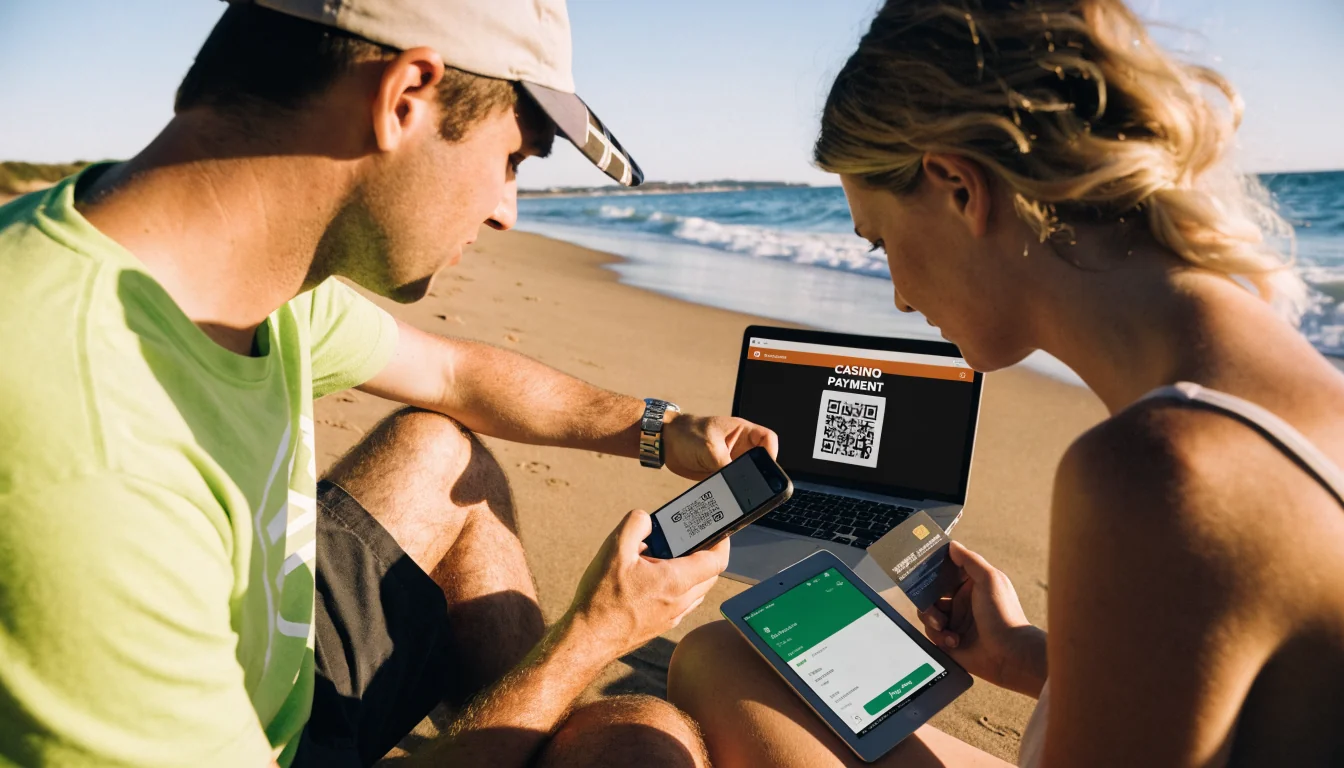
Bitcoin remains the most widely accepted option, and many crypto casinos also support Ethereum, Litecoin, USDT, Dogecoin, Solana, Ripple and other altcoins. Crypto deposits can be confirmed very quickly, often within minutes, while withdrawals clear in minutes with low fees under favourable conditions, or slow down when the operator requests paperwork and the blockchain becomes busy. Card‑led systems still appear on some platforms, yet they complicate what should be the simplest part of the whole exercise. A single industry review notes this complication when discussing payment preferences among operators.
Players who prefer not to fund an account at all can still collect real cash from no‑deposit slot promotions. Some offshore casinos award a small bundle of free spins or a token balance simply for opening an account, and any winnings that escape the wagering rules become withdrawable cash. The most common misunderstandings involve sending funds along the wrong blockchain, overlooking transaction fees, or assuming that crypto removes identity checks. A few platforms have native tokens that provide staking rewards and governance rights, according to one industry review.
The June 2024 amendment to the Interactive Gambling Act prohibits cryptocurrencies and credit cards on Australian licensed gambling sites, yet online lotteries and keno remain exempt from the ban. Offshore operators, by contrast, still accept digital currency, which explains why a modest deposit usually travels farther on those platforms than at domestically regulated sites. The choice of slot then becomes a question of temperament: low‑volatility machines pay frequently and sustain a small balance, while high‑volatility machines promise a single significant hit at the price of longer dry spells.

Sensible players set the stake small enough to preserve a session, enough spins to judge the game honestly, and enough information to decide whether the risk still looks reasonable. That is usually sufficient.
Australian‑Friendly Online Casinos and Slot Providers
The phrase "Australian-friendly" does quiet work in this market: the friendliness consists mainly in tolerating a legal situation that the operator would rather not discuss. Australian players can legally access offshore crypto casinos, since the Interactive Gambling Act 2001 targets providers rather than the people who play. The casinos calling themselves Australian-friendly are simply those willing to hold a door the law has not quite closed.
One industry review names GoldEx, King Johnnie, and Stellar Spins among the top crypto casinos accepting Australian players. That is one reviewer’s list, not a market verdict, and it deserves to be read as such — a snapshot, nothing more. Names rotate through such lists the way they rotate through sponsorship deals.
Where the Licences Come From
Offshore licensing is the standard arrangement. Many crypto casinos serving Australians operate from jurisdictions such as Curacao or Malta, where a licence can be obtained precisely because Australia does not issue one for online casinos. Curacao in particular has built a small industry on being the regulator of convenience. A licence from there is genuine, but its genuineness says more about paperwork than about player protection.
The IGA itself was introduced to protect the public, with a focus on harm minimisation. The offshore model sits awkwardly beside that intention: the harm-minimising law pushes players outward, and the outward operators minimise paperwork instead. A tidy loop, if one enjoys irony.
What Keeps Them Trustworthy
Trust, where it exists, comes from mechanism rather than medal. Reputable crypto casinos use provably fair algorithms, allowing players to verify randomness through cryptographic hashes rather than through faith in a distant regulator. Some platforms go further, operating on decentralized protocols in which no single company controls the funds or the outcomes — the audit is built into the architecture, whether or not anyone performs it.
That, for the moment, is the whole environment: a Commonwealth law written to protect, a handful of offshore registries willing to license, and mathematics doing the work a domestic watchdog cannot. Whether this amounts to trustworthiness is a question the market answers one withdrawal at a time.
Legal Landscape for Real-Cash Casinos in Australia
The regulatory architecture governing real-cash casino play in Australia rests on a single Commonwealth instrument and a history of legislative punctiliousness. The Interactive Gambling Act marked the point where federal law chose to draw a perimeter around what entertainment might legitimately be offered to residents, and where it located the responsibility for drawing that perimeter. The instrument has been amended repeatedly since its introduction, and occasional references to an earlier statute—the Interactive Gambling Act 1997—still circulate in industry discussion; the version actually in force across the federation is the 2001 Act, and it is the 2001 text that defines the present prohibition.

Under that Act, online casino-style games—slots, poker, blackjack, roulette, and their digital relations—are prohibited offerings within Australia. Not merely discouraged. Prohibited.
What the Prohibition Covers
The prohibition reaches the full catalogue of real-cash casino products. Any operation that offers remotely accessible slot machines, table games in digital or live-dealer form, or any equivalent wager-for-money entertainment is outside what may lawfully be provided to Australian residents. This extends to every conventional variation of the genre. The law does not grade games by aesthetic, by payout mechanism, or by underlying technology—a spinning reel built on a blockchain remains a spinning reel.
Importantly, the availability question does not pivot on licensing. There exists no domestic licence an operator could in principle obtain to run an online casino into Australian homes. The licensing shelves are bare by design, not by administrative lag.
Where the Law Points Its Finger
What the Act prohibits is the provision of the service. The penal architecture is trained on suppliers, not on the people who receive them. An individual Australian who plays at an offshore-licensed online casino breaches nothing under the IGA—the conduct that constitutes the offence is conducting the prohibited service toward Australians, not choosing to be the customer of one. This distinction is the single contingency that keeps the real-money sector viable at all: offshore operators continue to accept Australian traffic, and Australian residents remain legally able to transact with them. The operators assume the statutory risk, the player is spared it.

Recent Amendments
Legislative adjustment since the Act’s inception has consistently moved in one direction: closing the perimeter around how casino-style games can be delivered and funded. The trajectory favours prohibition of new technological wrappers before they acquire the appearance of tradition. Australia accordingly maintains, decade after decade, one of the strictest online-gambling regimes of the developed world, and real-cash casino play residing offshore remains a creation of that strictness rather than an exception to it.
Free‑Play Slots That Can Turn into Real Cash Wins
Free‑play promotions are one of the few genuinely open doors in Australia’s closed casino market. Because the Interactive Gambling Act 2001 prohibits domestically licensed online casino operators, Australians who want slots that pay real money often end up with offshore sites. From those sites, a free bonus can, in some cases, convert to cash that can actually be withdrawn.
The cleanest mechanism is the no‑wagering bonus: the operator credits free spins or bonus funds and lets players keep the result without the play‑through that usually makes “free” an ironic word. When wagering is genuinely absent, even a modest hit may become cashable — subject, of course, to the standard identity check before any withdrawal.
Other routes are less straightforward. Bonus spins with attached wagering can still pay, but only after the balance is cycled enough times to satisfy the terms; the cash is real only when it is finally unlocked. Some platforms also tokenise play, issuing native credits that act like casino chips. A handful of such tokens come with staking rewards or governance rights, according to one industry overview, but they are the exception, not the market standard.

There is also a caution worth stating plainly: sending funds on the wrong blockchain, ignoring transaction fees, or assuming crypto removes identity checks are common user mistakes. “No KYC” and “no wagering” mean different things, and the first does not excuse the second.
Short version: a free spin is not a promise.
How to Find Free Real‑Cash Slot Opportunities
The phrase "free slots that pay real cash" sits in a strange legal twilight in Australia. Offering online casino games domestically is prohibited outright — no licence for it exists, and none can be obtained. That means any Australian‑facing site advertising free real‑cash play is operating outside the local framework from the start. The legitimate offers, then, come from offshore operators, which individual Australians are not breaking the law by visiting. The law targets the provider, not the player. An odd arrangement, but a useful one.
Sorting genuine offers from traps comes down to a few habits:
- No‑deposit promotions. Some offshore casinos hand out spins or small balances with no purchase required. The legitimate ones state the terms openly; the questionable ones hide behind vague wording.
- No‑wagering bonuses. When winnings from free spins carry no playthrough, what comes out is simply cash. That structure is the clearest sign an offer is real rather than decorative.
- Offshore licensing. Platforms licensed in jurisdictions such as Curacao or Malta publish their credentials. A site that cannot name its licensing jurisdiction is best left alone.
The red flag is geography. Any "free real cash" casino claiming to be Australian‑licensed for online casino play is misrepresenting itself, because no such licence exists. Checking that one claim filters out most of the junk before any money moves.
Winning Real Cash: Tips for Successful Play
Chasing real cash from slots is less about luck than about choosing platforms where the money actually moves. At a crypto casino, withdrawals are usually instant or processed within hours, often clearing in minutes with low fees. Yet sources disagree on how reliable this is: one industry review notes that withdrawals also depend on casino approval and blockchain processing, which may delay them. The gap matters when deciding where to play.
Some platforms run on decentralised protocols, meaning no single company controls funds or outcomes. For players, that structure can remove the usual bottleneck of waiting for a central operator to approve a payout.
Responsible gaming remains the foundation. Set a budget before playing, take breaks, and treat any winnings as luck rather than income. Gambling Help Online offers support if the habit stops being fun.
What payment methods are available for Australian players at online casinos?
Since offshore operators accepting Australians have mostly moved to crypto, you can typically use Bitcoin, Ethereum, Litecoin, USDT, Dogecoin, Solana, and Ripple. Traditional card-led payment rails are generally slow and less commonly supported for real-money play.
Is online casino legal in Australia?
It is illegal to offer online casino gambling domestically and no local licences exist, as the Interactive Gambling Act prohibits these services. However, it is not illegal for individual Australians to play at offshore-licensed online casinos.
How do I claim a bonus at a bitcoin casino?
The specific claiming process is not detailed, but standard free-play demos and promotions can convert to real-cash winnings under very specific rules set by the offshore crypto platform.
How safe are my funds at a crypto casino?
Reputable platforms use provably fair algorithms to verify game randomness, and some operate on decentralized protocols where no single company controls funds. However, you must ensure the operator holds a valid offshore licence, such as one from Curacao or Malta.
How can I verify if a gambling operator is legal?
Domestic online casino operators cannot legally exist, so any real-cash platform you use must hold an offshore licence from jurisdictions like Curacao or Malta. You should check the operator’s website for their licensing authority and registration details.
What happens if I have a dispute with a crypto casino?
Because the casino operates offshore under licences from jurisdictions like Curacao or Malta, you must rely on the dispute resolution mechanisms of that specific licensing authority.